The Lib Dem Tortoise - Local Elections 2026

Last week’s elections were dramatic and, in some places, deeply worrying. Labour had a terrible night. The Conservatives continued their long collapse. Reform made gains. The Greens had some very strong results, especially in urban areas. It was another election that showed Britain is no longer living in a simple two-party political world.
Mark Pack described it well before the results came in. The question, he said, was whether the “Lib Dem tortoise” would keep moving forward. The party had already made net gains in seven consecutive rounds of local elections, the longest winning streak in our party’s history. The question was whether 2026 would make it eight. Spoiler alert: It did. (Mark Pack)
In the run up to any election, I am always surrounded by people who think that the whole world is going to stop at 10pm on polling day. Party activists throw everything at the campaign and there cannot possibly be any future beyond the close of the polls. However, the real world does actually continue on. Most people don’t vote in local elections (most council’s are reporting a turnout of below 50%). So why do local elections matter?
They matter because local government is where politics becomes real. Its where bins are collected, schools are built, planning decisions are made, children’s services are scrutinised, adult social care is delivered, parks are protected, libraries are fought for, and roads are repaired. It is also where voters can see, very directly, whether a political party is serious about public service.
And on that test, the Liberal Democrats swept the board.
Across England, more than 5,000 council seats were contested in 136 councils. All 136 councils were finally declared by Monday morning. The final results put the Liberal Democrats on 844 councillors elected, a gain of 152 compared with when those seats were last fought. That placed us well ahead of the Conservatives, who won 801 seats but lost 563. Reform topped the seat table with 1,455 seats, while Labour won 1,068 after losing 1,498. The Greens won 586 seats, up 440. (Sky News Election Results)
The council control figures tell another important story. Labour still kept control of the most councils in England, but fell to 28, down by 40. The Liberal Democrats took up control 15 English councils, which is an increase of 3. Reform controls 14, the Conservatives just 9, and the Greens 5. No overall control, or other-party control, rose to 65 councils. (Sky News Election Results)
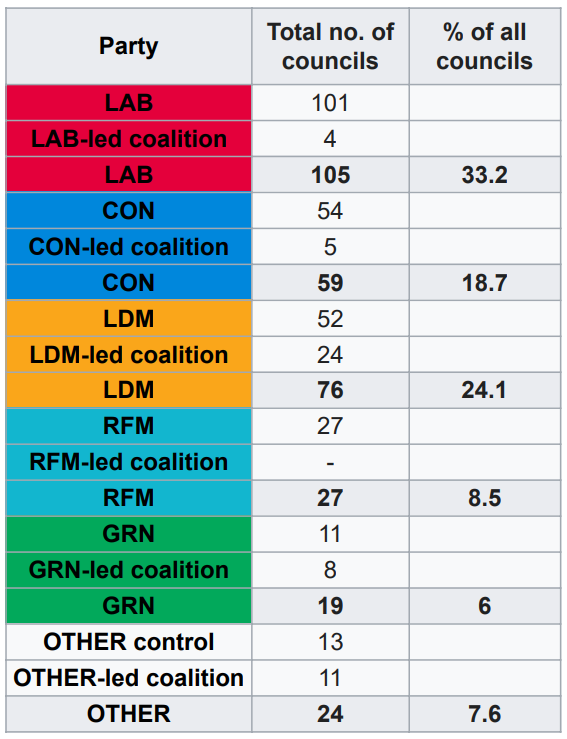
These elections have resulted in some interesting shifts in overall control of councils, with the current state of all English councils looking like this:
Or, if you prefer a more visual representation:
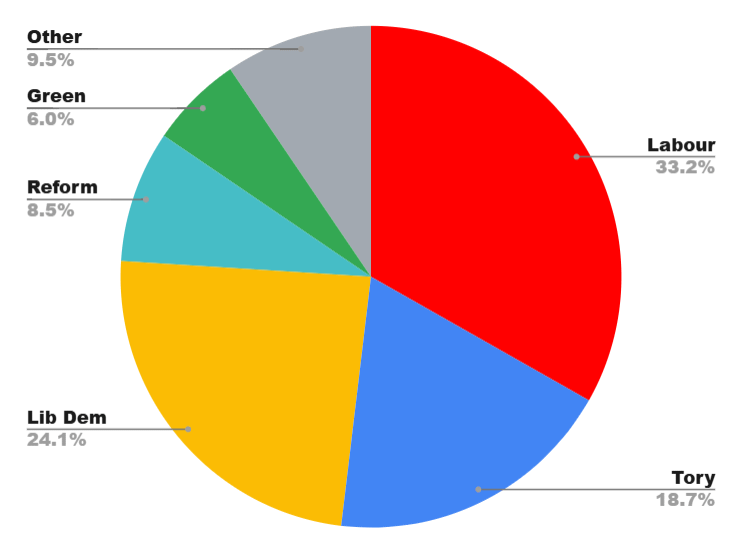
As you can see, the Lib Dems are hot on the heels of Labour and are set to very soon become the largest party of local government. To no-one’s surprise, Reform are part of zero coalitions.
So, did the Lib Dems do well?
Short answer: yes. Long answer: oh yeeeeeeess!
The news headline show the Green surge in parts of London and some urban areas. Reform picked up a large number of councillors due to the very real discontent felt by large parts of the electorate casting a protest vote.
However, our success was something much more familiar to Liberal Democrats: it was steady and disciplined, local growth.
The party gained councillors. We gained councils. We strengthened areas where we already run good local campaigns. We expanded into new areas. We continued to show that voters trust Liberal Democrats to get on with the job locally.
In almost every area with a Lib Dem MP or council, we made gains! Clearly, voters like having Lib Dem politicians around.
That is a very different kind of politics to the anger and grievance being offered elsewhere. Reform may have made gains, but they lose their councillors just as fast - averaging more than 2-a-day since these elections!
There is also another point worth making about Reform’s apparent momentum. While Reform had a very strong election night, there are already signs of serious instability beneath the surface. Mark Pack has been tracking councillors who have already been suspended, expelled, resigned or otherwise left the party since polling day. Just days after the elections, Reform had already shed at least eight councillors elected under its banner, including councillors suspended over allegations of racism, Holocaust denial, Islamophobic social media posts and other offensive conduct. One councillor in Essex resigned entirely after allegations relating to racist and Islamophobic content, while another in Sefton was declared “not welcome” by Nigel Farage himself following reports of Holocaust denial.
Similarly, between May 2025 and May 2026 Reform lost 73 councillors from a cohort of 677 elected - more than 10% in a year! They have lost their positions for everything from racist abuse, to financial misconduct, anti-social behaviour, and even just quitting Reform because it’s not right-wing enough.
Reform are an unserious political “party”, propped up by crypto-billionaires, run by grifters, and represented locally by a huge amount of deeply unpleasant people who just want to be allowed to air their unsanitary views in public.
Saying all that, I completely understand why people vote for them. Politics used to tread lightly on our lives, but has recently been pumped into our consciousness by social media algorithms and 24-hour news cycles that have realised there is money and clicks to be gained by political psycho-dramas. See Chris Mason frothing at the mouth this morning when Wes Streeting had a 17-minute meeting at 10 Downing Street. Because politics is invading people’s increasingly-sparse leisure time, people read the rage-bait headlines and get angry. This anger builds and builds from oft-untrue sources, but is then released at the ballot box. Talking to residents, I know that plenty of people are voting for Reform without knowing a single thing that they stand for. Hell, I’m pretty sure Reform now have councillors that have no idea what Reform stands for…
That matters because it highlights one of the key differences between protest movements and parties rooted in long-term local government. Winning a surge of votes is one thing. Building a disciplined, competent and sustainable local government base is something very different.
As you may have noticed, Reform’s vote share dropped 6% from last year’s local elections in England. As I’ve said before, Reform have peaked and are now in decline.
Liberal Democrats are not perfect, in fact at times I have described them as a bag of cats, but our councillors are usually deeply embedded in their communities, heavily involved in casework, and experienced in the practical realities of running councils. Reform and the Green’s rapid growth has often outpaced their vetting, organisation and local infrastructure. As a result, some of the cracks are already beginning to show only days after the ballots were counted.
Proportional representation - now!
In Exeter, we picked up another City Council seat! However, there was 9 votes between us, Reform, and the Tories. I feel that winning by 0.28% of the vote is an obviously farcical way to elect a representative.
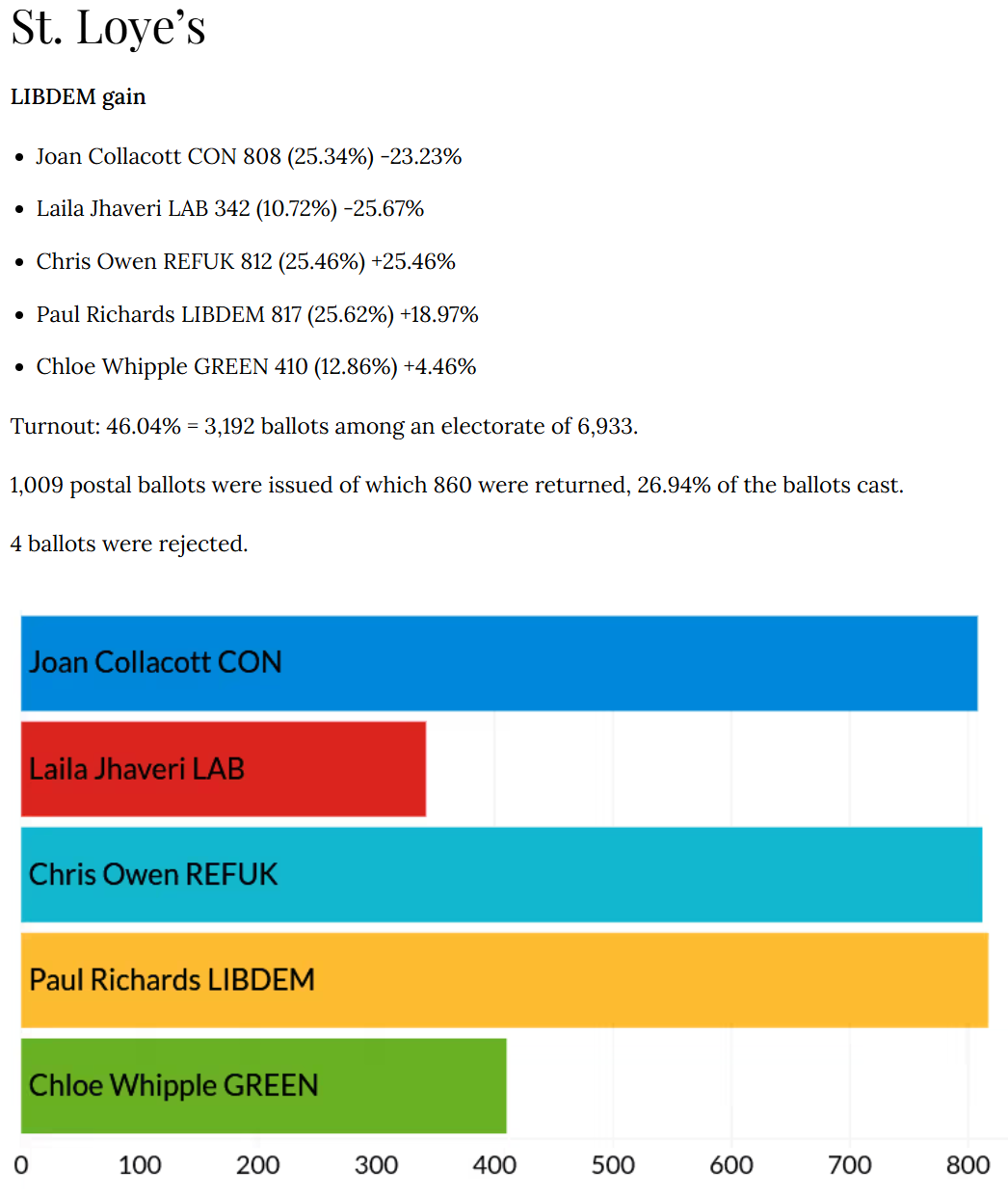
This result highlights the absurdity of First Past the Post (FPTP) voting systems, because even though it benefitted us this time, the vast majority of voters are not being represented by their choice of party. In a system of proportional representation, you could have 2 Lib Dems, 2 Reform, 2 Tories, 1 Labour, and 1 Green councillor represent this ward and it’s residents. That way, no votes would be wasted and everyone would be represented. You’d have to make wards 6x bigger to accommodate the increased representation without ballooning the number of councillors, but Wales has just shown that it’s possible and practical.
Where the Lib Dems did especially well
The strongest results came where Liberal Democrats have done the hard local work over many years - Like Duryard & St James in Exeter.
Richmond upon Thames was extraordinary. The Liberal Democrats won all 54 seats. A borough that, not so long ago, had Conservative MPs, a Conservative council and a Conservative London Assembly member is now represented entirely by Liberal Democrats at council level. Sky highlighted Richmond as a symbol of how deep Lib Dem strength has become in some areas. (Sky News)
I must admit I’m enjoying the memes popping up online comparing Richmond to North Korea in terms of lack of political opposition. I don’t think us liberals are to blame for this, fault lies with opposition parties offering exactly nothing to voters.
Sutton was another strong London result. The Liberal Democrats held control with 51 councillors, while the Conservatives were wiped out entirely and Reform won only two seats. (sutton.gov.uk)
Portsmouth was a major gain. The Liberal Democrats took control of the city council, moving from minority administration to majority control. Stockport was another big result, with ITV reporting that the Liberal Democrats secured the first party majority there for 15 years. (Sky News)
There were also important results in Surrey. In the new West Surrey council, the Liberal Democrats won 56 of 90 seats. In East Surrey, the Lib Dems won 40 of 72. That is exactly the kind of result that shows how parliamentary success, strong council campaigning and local credibility can reinforce each other. (ITVX)
Surrey! We took all of Surrey! The political seats of Jeremy Hunt, Geoffrey Howe, Michael Gove, Claire Coutinho, Crispin Blunt, and many more Tories.
Mark Pack also points to gains in places such as Brent, Camden, Ealing, Halton, Preston, Rugby, Southampton and Sefton. That matters because the Lib Dems cannot just be a party of our existing heartlands. We need to grow in former Labour areas as well as Tory, in urban areas, in towns, in suburbs and in communities where we have historically had only a small presence. (Mark Pack)
The organisation is growing too
One of the most encouraging details in Mark Pack’s analysis is not just the number of seats won, but the evidence of stronger organisation.
He reports that the proportion of vacancies contested by Liberal Democrat candidates was up by seven percentage points compared with the same point in the previous cycle. He also notes that the party had its best tally of local election candidates in London since 1986, that Lib Dem canvassing was up by over 25% compared with four years ago, and that polling day activity was at 83% of the level seen at the 2024 general election. (Mark Pack)
Leaflets matter. Door knocking matters. Casework matters. Local knowledge matters. Having candidates in place matters. Being known in the community matters.
This is the bit of politics that does not always make the national news, but it is the bit that builds trust. This is my favourite bit.
Scotland and Wales
The elections were not only about English councils.
In Scotland, the Liberal Democrats had a very good result, rising to 10 MSPs, a gain of 6. The party won 7 constituency seats and 3 regional seats. The Lib Dem constituency vote share was 11.4%, up 4.4 percentage points. (Sky News Election Results) We took a couple of serious scalps from the SNP!
In Wales, Jane Dodds was re-elected and the Liberal Democrats finished with 1 Senedd seat, a notional gain of 1 under the new boundaries and voting system. The Welsh result overall was dominated by Plaid Cymru and Reform, with Labour suffering a historic collapse. (Sky News Election Results). Jane is an impressive, serious, heavy-weight politician and one of the best speakers I saw at the Lib Dem conference last Autumn.
Again, the pattern is clear. Where we build locally and consistently, we win.
What this says about the Liberal Democrats
For me, the most important lesson is this: the Liberal Democrats are the party of local government.
Where Liberal Democrats run councils well, voters reward that work. They see cleaner streets, better recycling, stronger environmental policies, more responsive councillors and a culture of listening. They see councillors who are part of their communities, not distant figures who appear only at election time.
That is the kind of politics I believe in. Politics that is rooted in civilised local champions that do the hard work and earn votes. As a friend said to me the other day, “Reform just have zero decorum”.
We’re a clear contrast with Reform. Reform’s politics is built on grievance. It identifies problems, often real problems, but then points people towards anger, blame and division. That may win attention. It may win votes. But it does not repair roads, support children in care, fix social care, improve public transport or protect local libraries. We agree on lots of the problems that we face as a society, but we blame different people. Reform wants voters to blame the already-marginalised. Lib Dems point the blame at the billionaires and unregulated businesses that extort the rest of us.
The Liberal Democrat answer has to be different. We need to be the party of competent, compassionate, local government. The party that believes in fairness, tolerance, respect and kindness. The party that is pro-European, serious about the climate crisis, committed to public services, and rooted in the communities we serve.
My conclusion
We gained councillors. We gained councils. We made gains for an eighth consecutive year. We strengthened our local government base. We performed strongly in areas where we have built trust over time. We made progress in new places. We had a good result in Scotland. We held our place in Wales. We did very well.
But there is no room for complacency.
The rise of Reform is a warning, even though they have peaked in popularity. The fragmentation of politics is a warning. The collapse of the old two-party system is a warning. People are frustrated, and often with good reason. Public services have been underfunded for years. Councils have been asked to do more and more with less and less. Communities feel ignored. People want change.
The question is what kind of change they are offered.
Some parties offer the change of anger. Some offer the change of protest. Some offer the change of simple slogans that fall apart on contact with reality.
The Liberal Democrats offer something better: real change, rooted in local service, environmental responsibility, fairness, competence and hope.
As Mark Pack’s tortoise analogy suggests, it is the politics that keeps moving forward. And last week, once again, the Liberal Democrat tortoise relentlessly plodded forward, whilst the Green Duracell-bunny shot out the starting block, the hate-filled-hare of Reform started to get a stitch, the Labour-llama lost a leg, and the Tory-tarantula lies belly-up in a ditch. Okay, I’ll stop with the alliteration and tired-analogies, but you get the picture - the Lib Dems smashed it.